
Musée d’Orsay: a beautiful musem
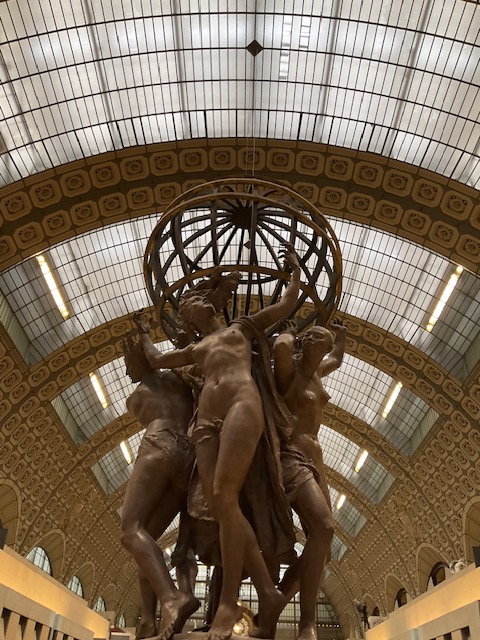
There are so many beautiful museums in Paris. One that I became very fond of during our visits was the Musée d’Orsay, located on the Seine River (the left bank) in the 7th Arrondissement. Pictured above is Jean-Baptiste Carpeaux, The Four Parts of the World Holding the Celestial Sphere, 1868-1872 (photo taken at the Musée d’Orsay, Paris).
Below are pictures of my journey on the way to the museum and of the museum itself. Also, I took many photos and videos of the artwork, and have included some of the photos in this blog, along with the name of the artist, the museum, and the title and date of the artist’s work. 1
History of Musée d’Orsay — originally a train station
According to the Musée d’Orsay Visitor Guide, it used to be a train station that became a protected monument in the early 1970’s and eventually a historical monument, which was finally converted to a museum. The free map of the Musée d’Orsay that you can pick up from the information desk is also full of information, noting that the government decided to convert the train station to a museum in 1977 and the museum officially opened in 1986. As we were walking through the Musée d’Orsay, we learned that the train station was transformed to house art that was basically a bridge between the artwork in the Louvre and the artwork in the National Museum of Modern Art. 2
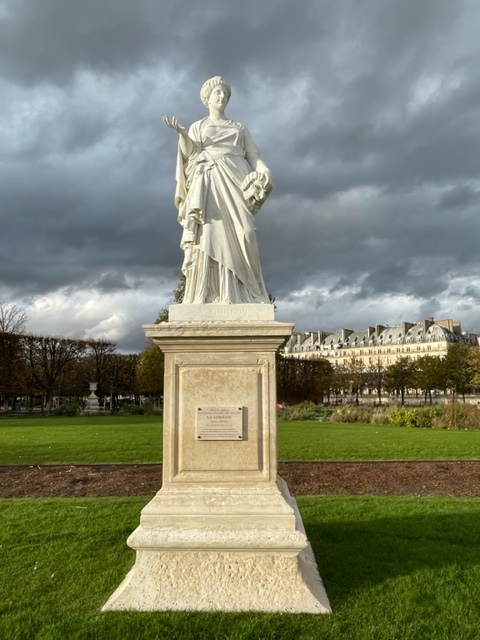
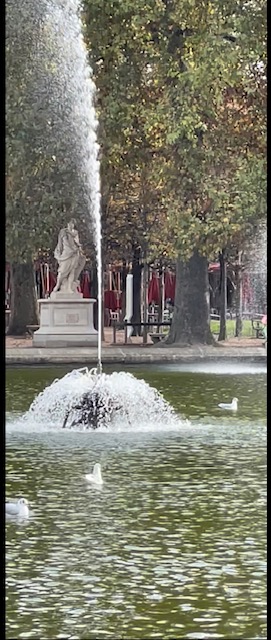
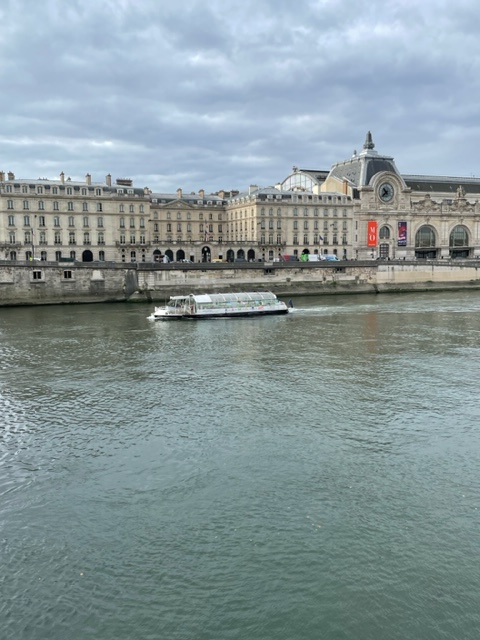
The Musée d’Orsay is separated by the Seine from Jardin des Tuileries (photos pictured above — the top photo is a statue titled La Comédie by Julien Roux, which is located in the Jardin des Tuileries). It’s about a 5 minute walk from the Jardin des Tuileries, which is an amazing garden to visit as well with beautiful sculptured statues, flowers, vegetation, shrubs, lush green lawns, and waterfalls throughout. Jardin des Tuileries has museums directly located off of it, including the Louvre and Musée de l’Orangerie. Often times, on my walk to the Musée d’Orsay, I would enter the Tuileries from the rue de Rivoli and walk through the gardens on my way to the museum.
Journey to Musée d’Orsay
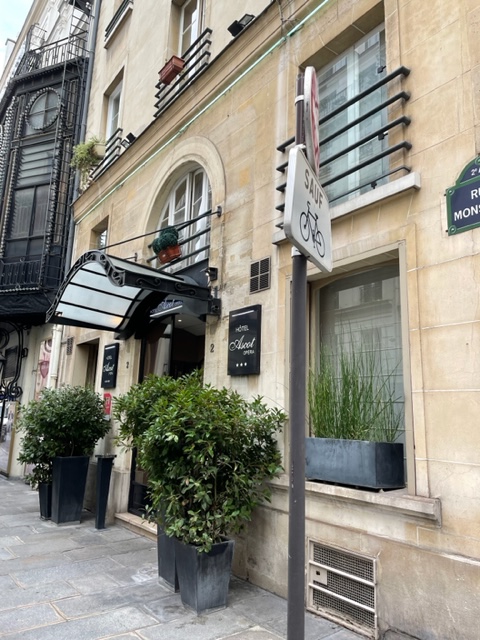
On one of my many visits to the Musée d’Orsay I walked from the Hotel Ascot Opera, at 2 Rue Monsigny in the 2nd Arrondissement, where I was staying. I eventually crossed a bridge on foot that went over the Seine, and stopped at La Frégate for espresso and a bite to eat. From there it was a short walk to the Musée d’Orsay.

It was a rainy day – perfect for touring a new museum. Upon entering, the space was very open and long — filled with breathtaking enormous sculptures and captivating art throughout. The museum has 5 levels (including a restaurant and café, bookstore & gift shop, and restrooms) and is packed with so much to see. I personally visited it at least 3 times and still want to go back again.
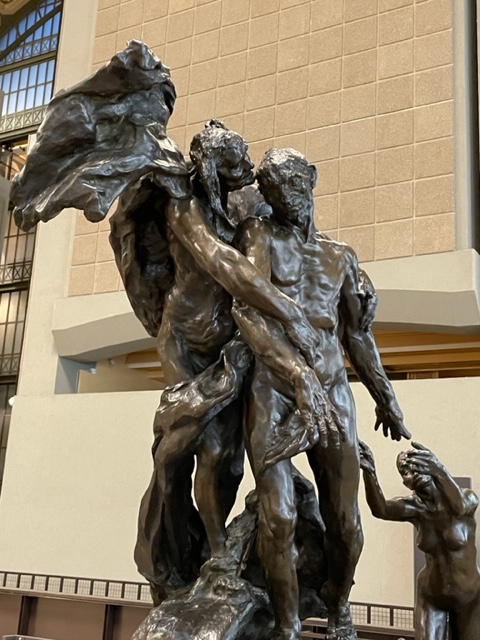
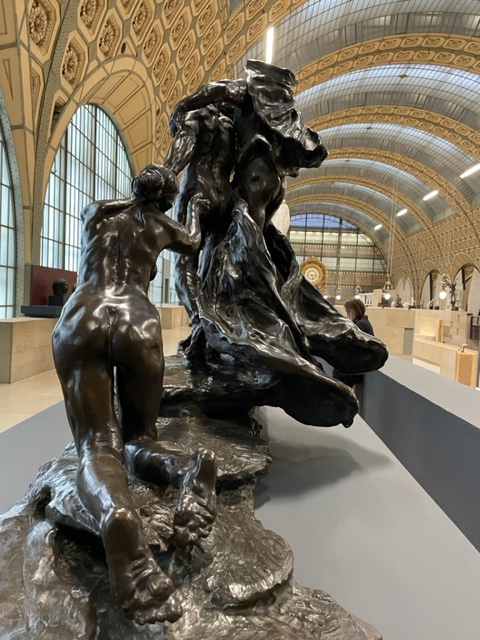
Among the artwork and sculptures, Camille Claudel’s sculpture titled “Maturity” was definitely one of the pieces of artwork that inspired me to want to know more about the sculpture and the artist. Additionally, it was my first exposure to Rodin’s “Gates of Hell” sculpture, which I eventually also saw at the Rodin museum, where many of Camille Claudel’s sculptures are also housed.
Camille Claudel’s L’Âge Mûr (Maturity)
(The following photos of Camille Claudel’s Maturity, 1895-1902, were taken at the Musée d’Orsay, Paris)
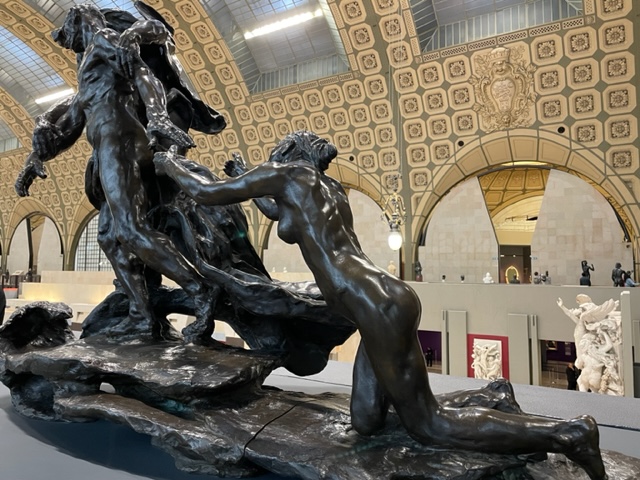
On my first visit to the Musée d’Orsay I went solo and purchased a Museum admission and the audio guide. On my second visit, I purchased the Guided tour plus a Museum admission, which was nice because I got an overview of the museum and saw parts of the museum that I wasn’t even aware of on my first visit.
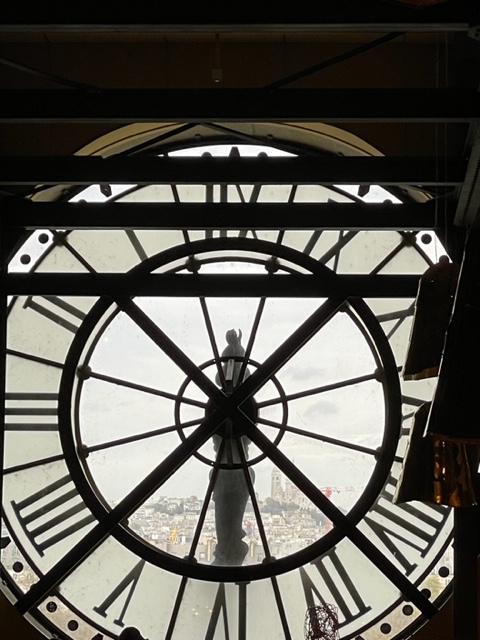
With the tour guide, we made it up to the 5th floor, where the big clock window was (pictured above) and the impressionists to neo-impressionist paintings (Degas, Monet, Pissarro, Renoir, etc.) and Post-impressionists (Toulouse-Latrec, Van Gogh, Gauguin, etc.) were. I was amazed to see all this as I had spent my first visit taking in numerous sculptures, such as Auguste Rodin’s and Camille Claudel’s, and other paintings throughout the museum on the lower levels.
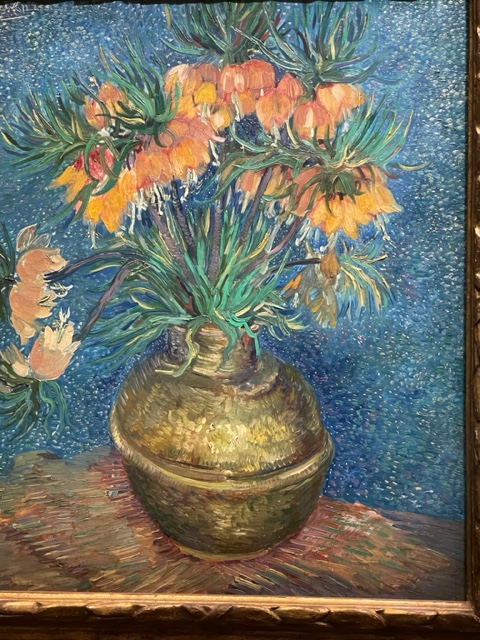
Among the many paintings at the Musée d’Orsay, is Van Gogh’s Fritillaires couronne imperiale dans un vase de cuivre, 1887 (photo taken at the Musée d’Orsay, Paris)
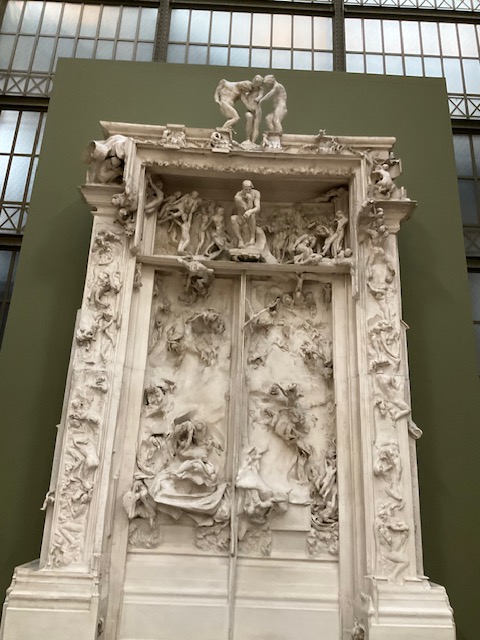
Rodin’s Gates of Hell, 1880-circa 1890, at the Musée d’Orsay (photo taken at the Musée d’Orsay, Paris)
The tour lasted approximately 90 minutes and from there you can wander around on your own. Also, because I had the guided tour I didn’t have to wait in a long line outside to get into the museum — I had priorty admission. On the way out, of course I stopped at the bookstore and got the Visitor Guide as well as other gifts, including a hard bound book by Christophe Averty, Musée d’Orsay (a version of this can also be found at amazon.)
As I said, there are so many beautiful museums to see in Paris and Musée d’Orsay is definitely one of them. If you’re planning a visit and can’t go now but would like to get an overview of the museum, the Musée d’Orsay website has videos and podcasts and numerous resources about the museum.
BrainyQuoteArt is contemplation. It is the pleasure of the mind which searches into nature and which there divines the spirit of which Nature herself is animated.
Auguste Rodin
- Please see disclaimer/terms of use on this website. ↩︎
- This information and more details about its history can also be found in the Musée d’Orsay’s Visitor Guide, the Musée d’Orsay’s free map, and if you sign up for a Guided Tour, the tour guide will fill you in on even more. The Audio Guide is also a wonderful way to gain knowledge about the museum and its collection. ↩︎
 katmsal.com